Your Cape Coral Mold Assessor (inspector) will identify the source of your
mold problem, the extent of the problem and write recommendations for corrections (removal) if he is a Certified Indoor Environmentalist
(CIE).
Your Cape Coral mold assessment (inspection) report must provide you
and the remediation company detailed documentation of the mold issues in order have the cleanup done properly. Our sample
mold inspection report shows you what you should expect from your Cape Coral mold inspector.
Cape Coral homeowners should understand that Certified
Indoor Environmentalists have proven they have the experience and knowledge to perform the best mold inspection for you.
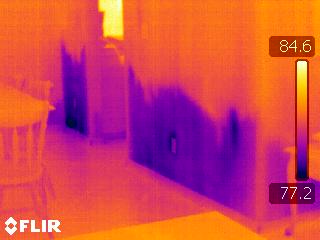
Infrared cameras are used by all professional mold assessors in
Cape Coral. Suspected moisture problems are always verified with a moisture meter.
.
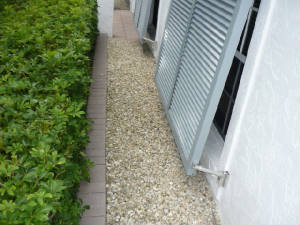
Rocks help reduce moisture build up
Moisture can wick up thru the concrete into the interior of your
Cape Coral home. Mold needs moisture to grow; rocks reduce moisture buildup around the exterior.
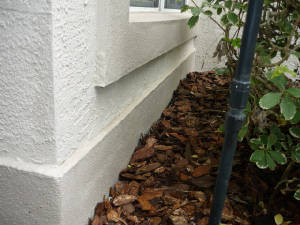
Wood Chips hold moisture
Wood chips in the photo above, hold moisture which benefits
the plants and shrubs. However this moisture can often find it's way into your Cape Coral home.
Your licensed Cape Coral mold assessor (inspector) should use an
infrared camera to help identify any moisture intrusions that may be the source of your mold growth problem.
Nationally -Certified Indoor Environmentalists (CIE) licensed
mold assessors have proven they have experience and passed an exam adopted by the state of Florida.
Radon & Mold Professionals CIE's
provide the BEST mold inspections in Cape Coral
You should not have mold growth in your Cape Coral home or business.
John Cosgrove has proven year after year he can identify your mold problem, document the problem and tell you what needs to
be done to remediate it (recommendations for corrections based on accepted industry standards). His detailed reports are often
copied by other mold assessors but his thorough inspections, experience and knowledge aren't duplicated.
Your Cape Coral home will always have mold spores inside it; they come in thru open doors and
windows or on people.
These mold spores don't grow until they find moisture (food and water),
you don't want mold growth in your home.
Organic materials provide food and even high humidity
can provide enough moisture for mold growth.
Naples / Bonita Springs:(239) 498-4619
Cape Coral / Ft Myers: (239) 948-9717
Cape Coral Mold Assessors (inspectors) will inspect all accessible areas
inside your home with infrared cameras, moisture meters and other equipment to determine a source for your mold problem.
After the inspection your Cape Coral mold inspector will issue a report identifying the source of your problem and the extent
of any mold problem. CIE's will also write recommendations for corrections based on nationally accepted industry standards
such as the S-520.
You CANNOT determine a Cape Coral home has a “Mold
Problem” based solely on Mold Air Samples alone.
Location
of mold, source of mold and extent of mold MUST be identified before calling a Remediation
Company.
·Mold Air Sampling (testing) is often used
to help determine if further investigation for mold is warranted in Real Estate transactions. ·Mold
Air Sampling (testing) is used to determine if visible mold has contaminated other areas of the home. If you have mold in one room, can you isolate that room or area and not clean the rest
of the home? ·Visible
molds should never be disturbed during air sampling as it can result airborne spores that may contaminate other
areas through the HVAC system. (Some molds are heavy “sticky” molds, about 8 to 10 microns, and do not normally
go airborne unless they are disturbed or there is a drastic humidity change.)
·You should be concerned about mold growth in a home.
·All molds can affect someone under the right conditions.
Air Sampling should always
be done in a CONTROLLED environment.
·Doors and windows should be closed 12 hours prior to air sampling (testing).(normal
entry & exit)
·No vacuuming or cleaning should
be done 12 hours prior to air sampling.
·Outdoors
Air sample (test) must be collected at least 10 feet from the structure. (NOT
on the lanai, balcony, in the garage etc.)